
For much of the twentieth century, the story of whales in the Southern Ocean was one of disappearance.
Industrial whaling had reduced many populations to a fraction of their former size, leaving scientists wondering how long recovery might take and whether some species would ever return to historical levels.
Decades later, the picture is beginning to look very different.
Across the Southern Hemisphere, researchers are documenting growing whale populations, and the return to historical habitats and behaviors that had become increasingly rare. While challenges remain, many whale populations are now recovering, such as humpback whales in the southwest Atlantic and southeast Pacific, as well as fin whales.
A recovery, decades in the making
International protections introduced during the second half of the twentieth century helped bring an end to large-scale commercial whaling. Since then, researchers have spent decades monitoring whale populations, migration routes, feeding grounds, and breeding areas.
Few species illustrate this trend more clearly than humpback whales.
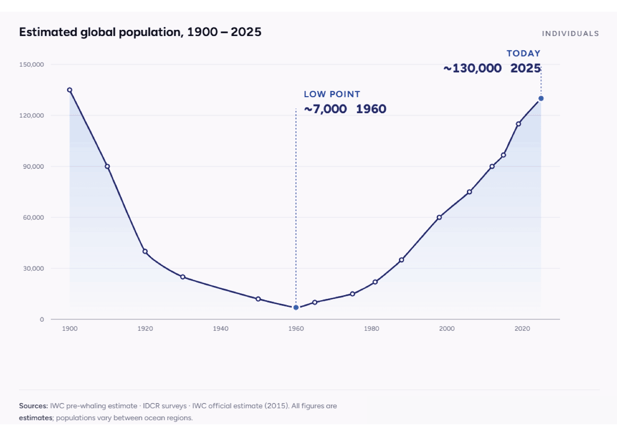
Scientists estimate that approximately 216,000 Southern Hemisphere humpback whales were killed between 1903 and 1973. Yet assessments conducted by the International Whaling Commission show that many humpback whale populations have grown steadily since protections were introduced. By 2015, the combined Southern Hemisphere population was estimated at roughly 70 percent of its pre-whaling abundance.
Recovery rates vary between regions and species, but many populations are growing, expanding their range, and reoccupying areas that had been largely abandoned during the whaling era.
Whales are returning to historical feeding grounds
Perhaps one of the most visible signs of recovery is where whales are being found.
In recent years, researchers studying fin whales near the Antarctic Peninsula have documented large feeding aggregations in areas heavily targeted by whalers during the twentieth century. For decades, very few fin whales were observed in these waters. Today, large groups are once again feeding in waters where sightings had become increasingly uncommon.
The researchers describe the return of these whales to ancestral feeding grounds, along with the reappearance of historical feeding behaviors, as strong evidence of population recovery.
When whales return to places where they have not been seen in substantial numbers for generations, it suggests that parts of the ecosystem are beginning to function more as they once did.
Why whale recovery matters beyond whales
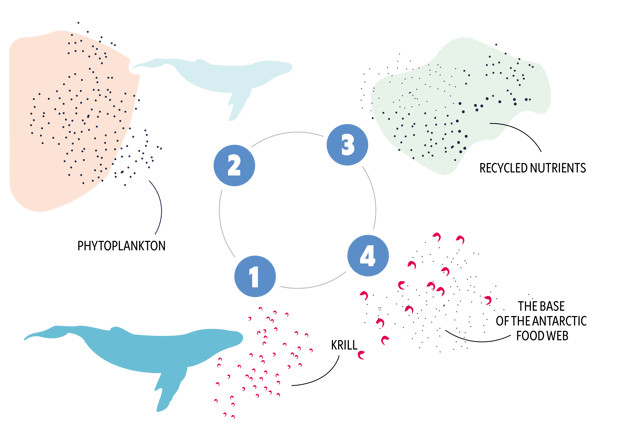
In the Southern Ocean, many whales feed on krill below the surface. Krill contains iron, nitrogen, phosphorus and other nutrients which is important for phytoplankton growth. When whales return to the surface and release waste, some of these nutrients are recycled back into the upper layers of the ocean, where phytoplankton can use it. Scientists call this process the "whale pump."
This is an important process because phytoplankton form the base of the Antarctic food web. These microscopic plants support the entire ecosystem, including krill, which in turn support whales, penguins, seals, fish, and seabirds.
As whale populations grow, researchers suggest they may help restore nutrient cycles and ecological functions that were weakened during the whaling era. Their return has implications for the wider Southern Ocean ecosystem, including its productivity and resilience.
A conservation success story still being written
The recovery of whales should not be mistaken for a signal that conservation work is finished.
Whales continue to face challenges, including climate change, ship strikes, entanglement in fishing gear, underwater noise, and changes in the distribution of prey. Not all populations and species are recovering at the same pace, and scientists continue to monitor how environmental changes may affect future trends.
Yet few researchers studying the Southern Ocean would have expected to witness whales returning to historical feeding grounds within their lifetimes. Today, those observations are becoming increasingly common.
The recovery remains unfinished, yet the return of whales to historical feeding grounds stands as one of the clearest signs of how populations can rebound when given time and protection.
Sources
- Humpback whale recovery, IWC: iwc.int/about-whales/whale-species/humpback-whale
- Bycatch in the Antarctic krill trawl fishery (Fisheries Management and Ecology, 2023): onlinelibrary.wiley.com
- Whale recovery context (Nature, Scientific Reports, 2022): nature.com/articles/s41598-022-13798-7
- Research on whale and fishing net interaction and solutions (ARK): ark-krill.org
- Humpback whale recovery, IWC: iwc.int/about-whales/whale-species/humpback-whale
- Post-whaling abundance and trends, Southern Hemisphere humpbacks (Frontiers in Marine Science, 2023): frontiersin.org
- Humpback recovery, general context (TIME): time.com
- Assessing the recovery of an Antarctic predator from historical exploitation (Zerbini et al, 2019) https://cascadiaresearch.org/files/Zerbini-AN.-et-al-2019-rsos.190368.pdf